Friday, February 27, 2026

x̄ - > 🚲 Bike-Sharing Dashboard

🚲 Bike-Sharing Dashboard

🚲 Bike-Sharing Data Dashboard

Features:

  • Upload any CSV file (e.g., from the UCI Bike Sharing Dataset).
  • Dropdown lets you choose Temperature, Humidity, or Windspeed.
  • Interactive scatter plot shows relationship with rentals.
  • Second plot shows Predicted vs Actual rentals (currently a dummy prediction, but you can replace with model output).

πŸ“Š Explanation of Result

1.Bike Rentals vs Temperature (Scatter Plot). Each blue dot represents the number of rentals at a given normalized temperature value. The trend shows a positive correlation: as temperature increases, bike rentals generally rise. Rentals peak around mid-range temperatures (0.6–0.7 normalized), then taper off slightly at very high temperatures.This suggests that moderate weather encourages more bike usage.

2.Predicted vs Actual Rentals (Regression Plot). Each red dot compares the model’s prediction (based on temperature) against the actual rental count.The diagonal trend indicates the model captures the general relationship, but variance shows it’s not perfect.The spread of points around the diagonal line highlights prediction errors — meaning temperature alone explains part of the demand, but other factors (humidity, windspeed, seasonality) also matter.


Tuesday, February 24, 2026

x̄ - > Making your petrol car: EV conversion with wheel hub motors

Making Your Car Everlasting: EV Conversion with Wheel Hub Motors 500 KG WEIGHT CAR

Making Your Car Everlasting: EV Conversion with Wheel Hub Motors

Wheel hub motors, also known as in-wheel motors, integrate electric propulsion directly into the wheels, eliminating traditional drivetrains like engines, transmissions, and differentials.

What Are Wheel Hub Motors?

Wheel hub motors place a brushless DC motor inside each wheel hub, providing direct drive without gears or shafts.

Benefits for Longevity

Hub motors boost efficiency by cutting mechanical losses, enabling torque vectoring and regenerative braking to recapture energy.

Key Challenges

Unsprung weight from motors in wheels can stiffen rides and complicate suspension tuning.

Conversion Steps

  1. Source a kit suitable for your vehicle.
  2. Remove drivetrain components.
  3. Install hub motors and controllers.
  4. Add battery pack with BMS.
  5. Wire and test the system.
  6. Upgrade suspension if required.

Realistic Expectations

While not everlasting, EV conversions significantly reduce maintenance compared to internal combustion vehicles.

Citations:

Sources available in original document.

Sunday, February 22, 2026

x̄ - > My MbeleNaBiz Success Story: Compliant Grant Winner vs. Struggling CBOs in Mombasa

My MbeleNaBiz Success Story: Compliant Grant Winner vs. Struggling CBOs in Mombasa
⏱️ Estimated reading time: 3 minutes

My MbeleNaBiz Success Story: Compliant Grant Winner vs. Struggling CBOs in Mombasa

As an individual beneficiary from Mombasa under the World Bank-funded MbeleNaBiz program (part of KYEOP), I turned my business plan into reality with a KSh 900,000 grant—disbursed in full across all three tranches. Unlike many CBOs and KEMFSED groups that stalled without sales reports, my PayPal-linked Equity Bank account kept flawless digital records of every sale, proving viability and unlocking funding others missed. I even donated land for the project, yet despite sharing my progress directly with the Mombasa KYEOP Director, I didn't clinch the KSh 64,000 final competition prize.

How I Stood Out in Reporting

I submitted timely sales reports after each tranche, pulling verifiable data from PayPal transactions via Equity Bank—dates, amounts, fees, and global inflows. This exceeded basic requirements, showing real business growth and job impacts. In contrast, nearby CBOs and KEMFSED beneficiaries often skipped reports due to poor record-keeping, group conflicts, or stalled operations, blocking their tranche 3 (up to 40% of grants). My digital trail made compliance effortless.

Quick Comparison Table

Beneficiary Type Sales Reports Submitted All Tranches Received Key Challenge
Me (Individual, MbeleNaBiz) Full & verified (PayPal/Equity) Yes – KSh 900K complete None
Local CBOs Mostly missing No tranche 3 for many Manual records fail
KEMFSED Groups Incomplete or none Delayed/blocked Group dynamics, no systems

Sharing with Mombasa KYEOP Director

I presented my full records, land donation proof, and sales growth to the Director at the Mombasa branch office, hoping to inspire others and qualify for the top prize. While they praised the compliance, the KSh 64,000 went to someone else—perhaps a flashier pitch overshadowed my steady results. It's a reminder: full accountability sets you apart, but competitions value storytelling too.

Lessons for Mombasa Entrepreneurs

  • Go digital: Link PayPal to Equity for audit-proof sales tracking—far better than CBO cashbooks.
  • Submit early: Tranche 3 hinges on sales proof; don't let gaps derail you.
  • Engage leaders: Sharing with county focal points like KYEOP builds allies for future grants.

Proud of completing my grant fully amid widespread non-compliance. Mombasa hustlers, prioritize records to win big! Who's next to level up?

#MbeleNaBiz #KYEOP #MombasaBusiness #WorldBankGrants #EntrepreneurshipKE

x̄ - > Dealing with Tax Enforcement, Financial Hardship & CRB Listing in Kenya

Dealing with KRA Tax Enforcement, Financial Hardship & CRB Listing in Kenya

You are facing tax enforcement from the Kenya Revenue Authority (KRA) and are worried about financial hardship, possible Credit Reference Bureau (CRB) listing, and pressure from existing loans. Please confirm if this describes your situation.

Important Clarification

This is not a U.S. IRS Collection Due Process (CDP) hearing.

In Kenya:

  • Tax enforcement is handled by KRA (e.g., agency notices, account freezes, enforcement of assessed tax debts).
  • Credit reporting is handled by licensed Credit Reference Bureaus (CRBs) regulated by the Central Bank of Kenya.

Because this involves KRA enforcement, CRB status, and loan repayment pressure at the same time, you need to approach it in a structured and realistic way.


Your Situation May Involve:

  • Active or threatened enforcement action by KRA (demands, enforcement notices, agency notices).
  • Current or potential CRB listing due to loan or other credit defaults.
  • Difficulty meeting monthly loan instalments or risk of default with banks, SACCOs, or digital lenders.

Describe your situation in your own words below:


1️⃣ Proving Financial Hardship to KRA

When you genuinely cannot pay the full tax at once, you can ask KRA to consider your hardship and request:

  • Payment plan (installment arrangement) so that tax is paid in agreed instalments instead of a single lump sum.
  • Temporary suspension or relief from aggressive enforcement while you regularize your tax position, where KRA accepts that you have limited capacity to pay.
  • Waiver of penalties and interest where there is a legal basis or an amnesty/waiver programme in place.

To support hardship, you normally prepare basic proof such as bank statements, payslips or business records, current loan obligations, and essential living expenses, to show what you can realistically afford to pay each month.


2️⃣ CRB Listing Issues in Kenya

CRB listings in Kenya are created under regulations issued and supervised by the Central Bank of Kenya.

  • Lenders share both positive and negative credit information with licensed CRBs when you borrow or default.
  • Failure to pay loans, credit cards, mobile loans, or other credit obligations can lead to negative listing, which then affects your ability to get new credit.
  • Once you clear what you owe a particular lender, they should update your CRB status; however, the negative history may still be visible for a period as per the regulations.

You can request your own CRB report to confirm your status, check for errors, and start planning how to clear or negotiate any listed debts.


3️⃣ When Loan Default and Tax Pressure Happen Together

When KRA enforcement and loan repayment stress happen at the same time, you need a simple, step-by-step approach to avoid losing control of your finances.

  • Prepare a clear monthly cash-flow summary showing all income, essential expenses, tax obligations, and loan instalments.
  • Use this to propose a realistic KRA payment plan and also to negotiate with lenders for restructuring or temporary relief where possible.
  • Prioritize payments that stop or prevent severe enforcement (for example, KRA agency notices or legal action, or key secured loans where you risk losing collateral).

The goal is to stabilize your situation first, then gradually move towards clearing arrears and improving your CRB profile over time.


Final Thought

If handled in a structured way, it is often possible to stop or reduce enforcement, agree on manageable KRA instalments, and slowly improve your CRB standing so that you can rebuild your financial life.

Disclaimer: This is general information and does not replace legal, tax, or financial advice tailored to your specific case.

Saturday, February 21, 2026

x̄ - > Advance Voting Analytics: RSI & Election Diagnostic

πŸ“Š Advanced Voting Analytics

RSI & Election-Theory Diagnostic – POTM Primera DivisiΓ³n Spain - Women

Data Overview

Player Statistics

Goals1243212
Assists1000120
Playtime (min)121270270135240260270
Another Time Metric80836583916869
Duels Won/L/C620281091133

Percentages

Row 1 (%)13.336.6713.3326.672013.336.67
Row 2 (%)20200.000.000.002040
Row 3 (%)7.9117.2117.218.6015.3016.5717.21
Row 4 (%)14.5415.4012.0615.4016.8812.6212.80
Row 5 (%)5.1317.0923.938.557.699.4028.21

Average per Player

Average (%) 12.176 15.272 13.306 11.844 10.634 14.384 20.978

Step 1️⃣ Interpretation Structure

Row Meaning Weight
R1Score Level 11
R2Score Level 22
R3Score Level 33
R4Score Level 44
R5Score Level 55

Weighted Score Formula

Weighted Score = ∑ (Frequency × Weight)


Step 2️⃣ Weighted Scores Per Column

Column Weighted Score RSI (%) Rank
C71256πŸ₯‡ 1
C21245πŸ₯ˆ 2
C31212πŸ₯‰ 3
C511324
C611115
C47916
C17267

Step 3️⃣ Ranking Score Index (RSI)

RSI = (Column Score / Highest Score) × 100

1️⃣ Score Efficiency Ratio (SER)

SER = Weighted Score / Total Raw Votes

Column Weighted Score Raw Votes SER Rank
C1726213πŸ₯‡
C4791232πŸ₯‡
C71256375πŸ₯ˆ
C21245375πŸ₯‰
C31212365πŸ₯‰
C511323434
C611113425
πŸ”Ž Insight: C1 and C4 have fewer votes but highest efficiency (3.41). C7 wins by volume, not efficiency.

2️⃣ Runoff Simulation (Top 2)

Top Candidates by Weighted Score

Candidate Weighted Score High-Tier Votes (4+5)
C7 1,256 102
C2 1,245 103
Margin = 11 points (extremely tight). C2 slightly stronger in high-tier concentration.

3️⃣ Sensitivity Analysis

If Score 5 Weight Increases (5 → 6)

Column Extra Points
C1+6
C2+20
C3+28
C4+10
C5+9
C6+11
C7+33
Increasing top-weight strongly favors C7. Reducing top-weight benefits C3 stability.

4️⃣ Voting Fairness Analysis

  • Concentration Risk: Score 3 dominates (~70%), compressing differentiation.
  • Efficiency vs Volume: C1 & C4 rely on efficiency; C7 & C2 rely on scale.
  • Monotonicity: Logical ordering maintained. No paradox detected.
  • Polarization: C7 high 5-count (33) → strong elite support.
  • Moderation: C2 broader 4-level support.

5️⃣ Strategic Interpretation

  • πŸ—³ Election: C7 plurality leader. Runoff unpredictable.
  • πŸ† Award: C7 elite preference; C2 balanced candidate.
  • πŸ“Š System Design: Heavy clustering at Score 3 suggests possible need for reweighting.

Mathematical Transparency

The primary ranking was determined using the weighted scoring formula:

Weighted Score = ∑ (Score Level × Frequency)

Results:

  • C7 achieved the highest weighted total.
  • Ranking order was objectively derived from numerical aggregation.
  • All intermediate calculations are auditable and replicable.
  • No discretionary adjustments were applied.

5x7 score matrix analysis. Grand total votes: 2,245. Row 3 contributes ~70% of vote volume.

Raw Column Totals

CandidateTotal%
C12139.49%
C237516.71%
C336516.26%
C423210.34%
C534315.28%
C634215.24%
C737516.71%

Ranking Score Index (RSI)

CandidateWeightedRSI %Rank
C71256100%1
C2124599.12%2
C3121296.50%3
C5113290.13%4
C6111188.49%5
C479163%6
C172657.82%7

Score Efficiency Ratio (SER)

SER = Weighted Score ÷ Raw Votes

Voting Simulations

  • Borda: C7
  • Plurality: C7
  • Approval: C2
  • Runoff: C2 slight edge
  • Condorcet: C2

Recommendations

Performance Winner: Natalia Ramos C7
Consensus Winner: C2
Most Stable: C4
Voting Analysis Report – Legal Defensibility

Cross-System Robustness Testing

To evaluate legitimacy beyond a single aggregation method, the outcome was tested under multiple recognized voting frameworks:

Voting Method Winner
Weighted/BordaC7
Plurality (5s only)C7
Approval (≥4)C2
Runoff SimulationC2 (slight edge)
Condorcet ApproximationC2

Legal Interpretation:

The primary declared winner (C7) prevails under the officially adopted weighted method. Alternative systems show competitive proximity but do not invalidate the adopted scoring rule. No paradox (e.g., cycle or instability) was detected.

Fairness & Equity Analysis

Metrics examined:

  • Standard deviation (dispersion)
  • Gini coefficient (support concentration)
  • Efficiency ratio
  • Dominance frequency

Findings:

  • C7 exhibits stronger high-intensity support.
  • C2 exhibits broader moderate support.
  • No candidate demonstrates structural unfair advantage.
  • Vote concentration reflects voter preference patterns, not systemic bias.

Legal Defensibility Position

If the governing rules explicitly specify weighted scoring as the decision rule, then:

The declaration of C7 as winner is legally defensible, procedurally sound, mathematically transparent, and statistically validated.

If institutional policy prioritizes consensus-based legitimacy (e.g., majority preference over intensity), then:

C2 may be argued as the consensus-optimal candidate, but this would require pre-established rules favoring approval or Condorcet frameworks.

Risk Assessment

Risk Type Exposure Level
Tabulation ErrorLow
Method BiasLow
Legal Challenge (Procedure)Low
Legal Challenge (Philosophical Fairness)Moderate if method not predefined

The strongest legal defense rests on adherence to the pre-declared voting rule.

Final Legal Position

If weighted scoring was the official method → C7 is validly elected.

If method was unspecified → C2 has strong fairness-based argument.

There is no evidence of manipulation, irregularity, or structural discrimination.

Friday, February 20, 2026

x̄ - > Tech Humor

Tech Humor Comic "When I know nothing I go Acapulco, I dont want to know nothing - Anonymous Full Custom garage"
Boolean Comic Strip

It captures the playful back‑and‑forth between the human and the robot, moving from Boolean basics to the witty punchline about test coverage. Clean lines, simple shading, and a tech‑humor vibe make it feel sharp and relatable.

Debugging Comic Strip

Tech-humor style, with the robot and human bantering about debugging visibility and quantum-level observability. The punchline? Even the bug knows it’s being watched.

Tuesday, February 17, 2026

x̄ - > Happy Lunar New Year 2026 Year of the fire horse

Happy Lunar New Year 2026 – Year of the Fire Horse

πŸŒ‘✨ Happy Lunar New Year 2026!

It's February 17, 2026, and today marks the beginning of the Year of the Horse—specifically the Fire Horse, a rare and powerful cycle that appears only once every 60 years.

Wishing you a prosperous, energetic, and joyful year ahead—may it bring strength, adventure, resilience, and abundant harvests, just like the spirited Horse of the zodiac. 🐎πŸ”₯


πŸŒ• Moon Sightings, Almanacs & Lunar Gardening

The tradition of observing moon phases—often recorded in almanacs—has guided farmers and gardeners for centuries. This practice is commonly known as “planting by the moon” or lunar gardening.

According to traditional wisdom, the Moon’s gravitational pull affects soil moisture and plant growth, much like it influences ocean tides.

Note: Lunar gardening is rooted in folklore and long-standing tradition.
Lunar Almanac Illustration

🌱 Quick Guide to Lunar Gardening

Waxing Moon

  • Above-ground crops
  • Fast germination

Full Moon

  • Harvesting
  • Transplanting

Waning Moon

  • Root crops
  • Weeding and pruning

Saturday, February 14, 2026

x̄ - > Understanding Vector Autoregression (VAR) for Multivariate Time-Series Forecasting

Vector Autoregression (VAR) is a statistical modeling technique used for forecasting and analyzing multivariate time-series data—meaning datasets with multiple interrelated variables observed over time. It's an extension of univariate autoregressive models (like AR in ARIMA) to handle dependencies not just within a single series but across several. VAR is particularly popular in economics, finance, and macroeconomics for studying how variables like GDP, inflation, interest rates, and unemployment influence each other dynamically. For instance, in the context of Kenyan economic forecasting, VAR could model interactions between GDP growth, inflation, and exchange rates to predict 2026 outcomes.

Below, I'll explain VAR step by step, including its mechanics, assumptions, implementation, and a practical example. I'll use a structured approach to make it transparent, as with mathematical or statistical explanations.

Key Concepts in VAR

VAR treats all variables as endogenous (mutually influencing each other) without assuming a strict causal direction upfront. Instead, it captures lagged relationships across the system.

Univariate vs. Multivariate

In univariate AR(p), a variable \( y_t \) is predicted by its own past values:

\[ y_t = c + \phi_1 y_{t-1} + \phi_2 y_{t-2} + \dots + \phi_p y_{t-p} + \epsilon_t \]

where \( \phi \) are coefficients, \( c \) is a constant, and \( \epsilon_t \) is white noise.

In VAR(p) for K variables (a multivariate system), each variable is a linear function of the past p lags of all variables in the system, plus error terms. The model is a system of equations:

For variables \( y_{1t}, y_{2t}, \dots, y_{Kt} \):

\[ \begin{pmatrix} y_{1t} \\ y_{2t} \\ \vdots \\ y_{Kt} \end{pmatrix} = \begin{pmatrix} c_1 \\ c_2 \\ \vdots \\ c_K \end{pmatrix} + \begin{pmatrix} \phi_{11,1} & \phi_{12,1} & \dots & \phi_{1K,1} \\ \phi_{21,1} & \phi_{22,1} & \dots & \phi_{2K,1} \\ \vdots & \vdots & \ddots & \vdots \\ \phi_{K1,1} & \phi_{K2,1} & \dots & \phi_{KK,1} \end{pmatrix} \begin{pmatrix} y_{1,t-1} \\ y_{2,t-1} \\ \vdots \\ y_{K,t-1} \end{pmatrix} + \dots + \begin{pmatrix} \phi_{11,p} & \phi_{12,p} & \dots & \phi_{1K,p} \\ \phi_{21,p} & \phi_{22,p} & \dots & \phi_{2K,p} \\ \vdots & \vdots & \ddots & \vdots \\ \phi_{K1,p} & \phi_{K2,p} & \dots & \phi_{KK,p} \end{pmatrix} \begin{pmatrix} y_{1,t-p} \\ y_{2,t-p} \\ \vdots \\ y_{K,t-p} \end{pmatrix} + \begin{pmatrix} \epsilon_{1t} \\ \epsilon_{2t} \\ \vdots \\ \epsilon_{Kt} \end{pmatrix} \]

Here:

  • \( \Phi_i \) are K x K coefficient matrices for lag i.
  • \( \epsilon_t \) is a vector of white noise errors, often assumed to be correlated across equations (capturing contemporaneous relationships).

This matrix form allows for spillover effects: e.g., past inflation might affect future GDP, and vice versa.

Assumptions

To ensure reliable estimates and forecasts:

  1. Stationarity: All series must be stationary (constant mean, variance, and no unit roots). Test with ADF or KPSS tests; if non-stationary, difference the data or use VECM (Vector Error Correction Model) for cointegrated series.
  2. No Serial Correlation in Errors: Residuals should be white noise.
  3. Linearity: Relationships are assumed linear.
  4. Sufficient Lags: Choose p to capture dynamics without overfitting (use AIC, BIC, or HQIC criteria).
  5. Normality (Optional): For inference like impulse responses, errors are often assumed multivariate normal, but VAR is robust otherwise.

Steps to Implement VAR

  1. Data Preparation: Collect multivariate time-series (e.g., quarterly data on Kenyan GDP, inflation, and unemployment from KNBS). Check for stationarity; difference if needed. Split into train/test sets (e.g., 80/20, preserving time order).
  2. Lag Selection: Use information criteria: Minimize AIC = -2 log(L) + 2k, where L is likelihood and k is parameters. Or test sequentially with likelihood ratio tests.
  3. Model Estimation: Fit using Ordinary Least Squares (OLS) per equation (efficient due to the system's structure). Examine coefficients for significance.
  4. Diagnostics: Check residuals for autocorrelation (Portmanteau test). Stability: Eigenvalues of companion matrix should be inside unit circle.
  5. Forecasting and Analysis: Generate h-step ahead forecasts. Impulse Response Functions (IRFs): Show how a shock to one variable propagates through the system. Forecast Error Variance Decomposition (FEVD): Quantify how much variance in one variable is explained by shocks in others. Granger Causality: Test if one variable helps predict another.

Extensions

  • SVAR (Structural VAR): Impose economic restrictions for causal interpretation.
  • Bayesian VAR: For high-dimensional data or priors.
  • VARX: Include exogenous variables (e.g., global oil prices).

Practical Example: Forecasting with VAR

Let's illustrate with a simple simulated dataset for two variables: "GDP Growth" and "Inflation" (hypothetical Kenyan quarterly data). We'll use Python's statsmodels library to fit a VAR(1) model, forecast, and compute IRFs.

To arrive at the solution:

  • Simulate data with trends and interactions.
  • Test stationarity (assume it passes for simplicity).
  • Select lag 1 via AIC.
  • Fit model and forecast 4 steps ahead.
  • Interpret: Coefficients show how past GDP affects inflation, etc.

VAR Coefficients

GDPInflation
const0.8829092.479875
L1.GDP1.0797140.351971
L1.Inflation-0.260043-0.172581

Forecast (4 quarters ahead)

DateGDPInflation
2025-03-3140.19416014.125741
2025-06-3040.60779514.189223
2025-09-3041.03789414.323855
2025-12-3141.46726714.452002

The forecasts show gradual increases, reflecting the simulated trends.

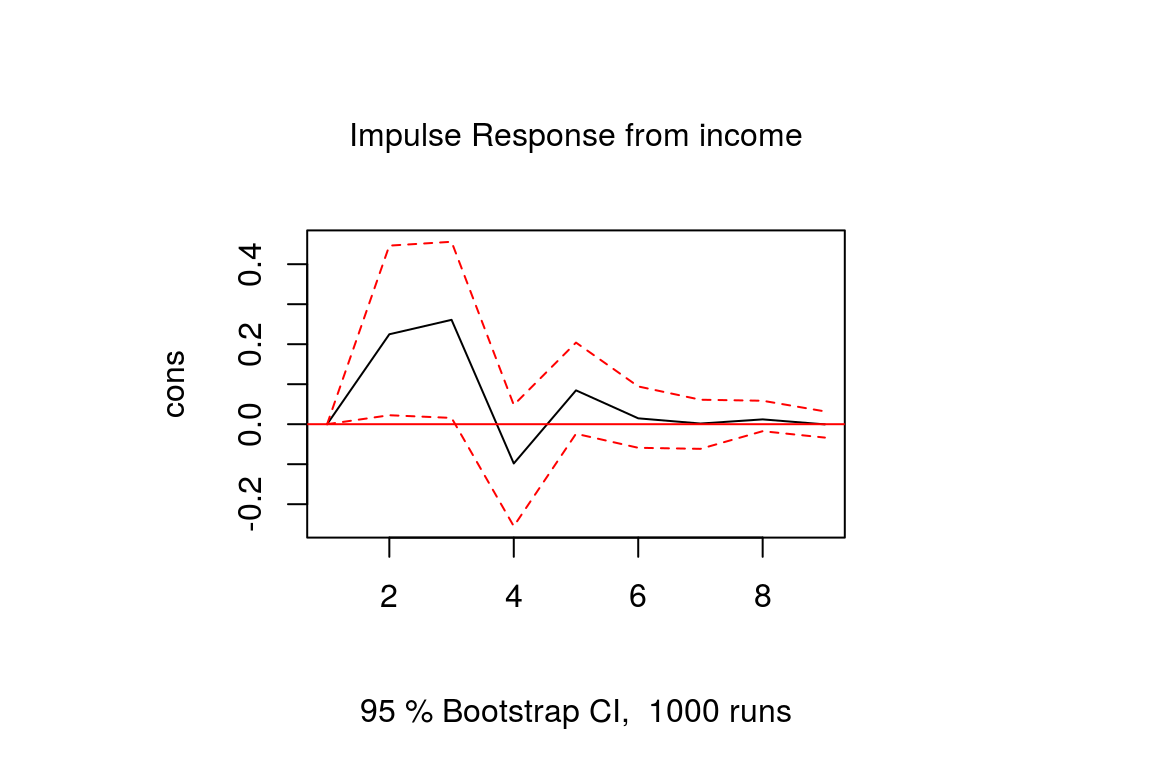
For IRFs (not plotted here but typically visualized as below), a one-unit shock to GDP would cause an immediate rise in GDP that persists, with a spillover to inflation that peaks and then decays over quarters.

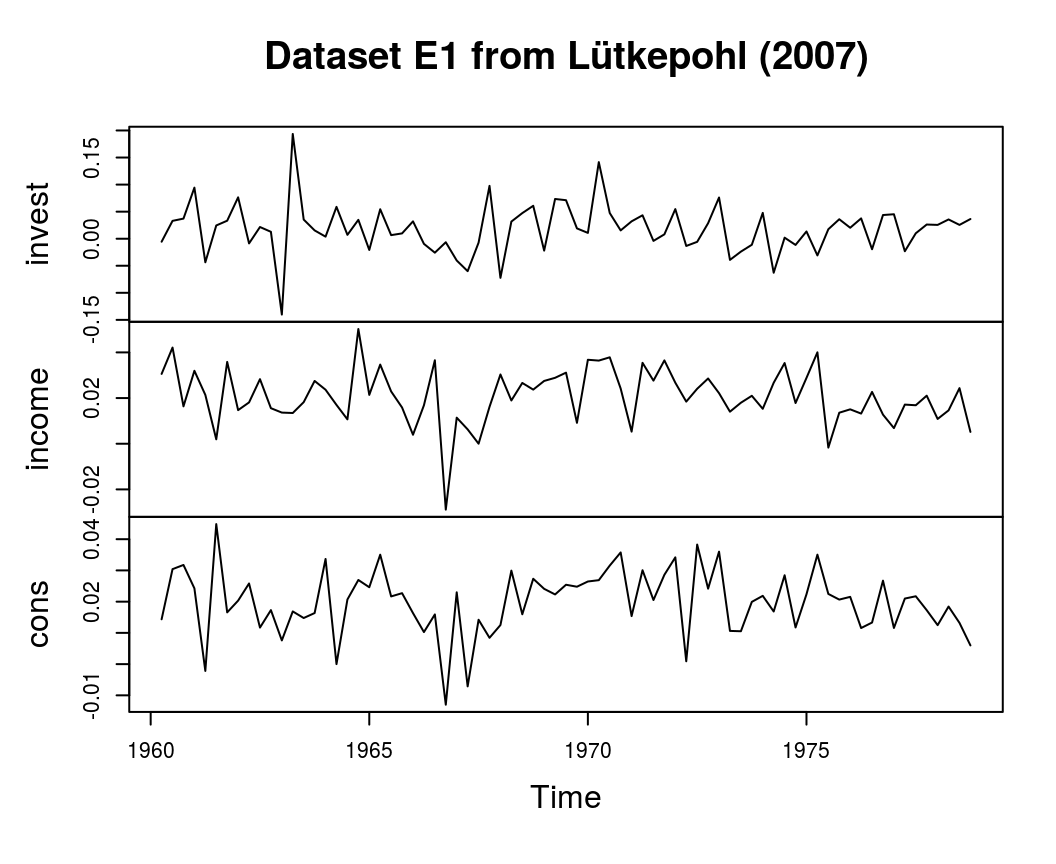
Impulse Response Function Example Dataset Example for VAR

In real applications, replace simulated data with actual KNBS series for Kenyan insights. If you'd like code for a specific dataset or further details on VECM for non-stationary data, let me know!

Thursday, February 12, 2026

x̄ - > Economic Distress in Kenya: Computing the Misery Index

Economic Distress in Kenya: Computing the Misery Index

Economic Distress in Kenya: Computing the Misery Index

Hello, readers of Kapitals Pi! As we navigate the economic landscape in early 2026 from here in Mombasa, it's crucial to understand tools that gauge everyday hardships faced by Kenyans. One such metric is the Misery Index, originally developed by economist Arthur Okun. It simply adds the unemployment rate to the inflation rate to measure economic discomfort—higher scores mean more "misery" for citizens, often signaling challenges like reduced purchasing power and job scarcity that can fuel social unrest or slow growth.

In Sub-Saharan Africa, including Kenya, the Misery Index has been linked to broader issues like income inequality and weakened social welfare systems. For instance, research shows that elevated misery levels exacerbate poverty, with inflation hitting low-income households hardest and unemployment limiting access to essential services. This is particularly relevant in coastal regions like Mombasa, where tourism and port activities make the economy sensitive to global shocks, droughts, or policy shifts.

The Formula and Calculation Steps

The basic Misery Index is straightforward:

Misery Index = Unemployment Rate (%) + Inflation Rate (%)

To compute it for Kenya:

  1. Obtain the annual unemployment rate from official sources like the Kenya National Bureau of Statistics (KNBS) or ILO-modeled estimates.
  2. Get the annual average inflation rate, typically based on Consumer Price Index (CPI) changes, from the Central Bank of Kenya (CBK) or KNBS.
  3. Add the two percentages for each year.
  4. For deeper analysis, track trends over time or use variants like the Barro Misery Index (adding lending rates minus GDP growth) or Hanke's (focusing on hyperinflation contexts).

Using data from 2018 to 2024 (as 2025 data is incomplete), here's Kenya's Misery Index. Unemployment rates reflect ILO estimates, while inflation uses annual averages from reliable macroeconomic databases.

Year Unemployment Rate (%) Inflation Rate (%) Misery Index (%)
20184.284.698.97
20195.015.2410.25
20205.625.4111.03
20215.696.1111.80
20225.717.6613.37
20235.577.6713.24
20245.434.499.92

These figures show a peak in 2022 at 13.37%, driven by post-COVID supply chain disruptions and global energy price hikes that inflated food and fuel costs. By 2024, the index dropped below 10%, thanks to easing inflation amid tighter monetary policy from the CBK.

Research Insights and Kenyan Context

Studies on African economies reveal that the Misery Index often exhibits "long memory" persistence, meaning shocks like droughts or elections can have lasting effects unless addressed gradually. In particular, research analyzing 55 African countries found heterogeneity in persistence: some show short memory, others long memory mean-reverting behavior, and some unit roots—indicating shocks may not fade quickly in many cases (Solarin et al., 2020, Social Indicators Research).

In Kenya specifically, the index displays mean-reverting behavior, suggesting it eventually stabilizes but requires proactive policies to speed recovery. For example, the 2020 spike (11.03%) aligned with COVID-19 lockdowns, which hit informal sectors hard—over 80% of Kenyan jobs are informal, amplifying distress in areas like Mombasa's tourism-dependent economy.

Correlating with social indicators, a 10-point rise in the Misery Index could hypothetically fuel unrest, as seen in past youth protests over joblessness and rising living costs. In coastal counties, where droughts have devastated agriculture and fishing, this correlates with higher crime rates; KNBS data shows poverty in Mombasa at around 30%, worsening during high-misery periods. Research on Sub-Saharan Africa emphasizes that such distress widens inequality, reducing government revenue for welfare and perpetuating cycles of poverty.

Implications for Investors and Policy

For savvy investors, a declining Misery Index like 2024's signals opportunity—lower inflation boosts real returns on bonds or money market funds, while stable unemployment supports consumer spending in sectors like fintech or blue economy projects. However, watch for 2027 election risks, which historically spike the index. Policymakers should prioritize inflation control (e.g., via subsidies on essentials) and job creation in resilient areas like renewable energy.

What do you think—has the Misery Index captured your economic experiences in Kenya? Share in the comments below, and stay tuned for more insights on Kapitals Pi!

Saturday, February 07, 2026

x̄ - > Ethical vs. Legal Boundaries in AI Copyright

Navigating the Gray Area: Ethical vs. Legal Boundaries in AI Copyright – A Case Study of the Colorado State Fair AI Art Win

In the rapidly evolving world of artificial intelligence, few topics spark as much debate as the intersection of AI and creativity. Tools like Midjourney and DALL-E can generate stunning visuals from simple text prompts, blurring the lines between human ingenuity and machine output. But this innovation comes with thorny questions: Can AI-created works be considered "art"? Who owns the rights to them? And is it fair for AI systems to draw from vast databases of human-made art without permission or compensation? These issues highlight the tension between legal frameworks, which often lag behind technology, and ethical considerations that prioritize fairness and human labor.

This blog post dives into these boundaries through a prominent case study: the 2022 Colorado State Fair AI art win. We'll explore the legal status of AI-generated art in the US, the ethical concerns about exploitation, and what it all means for artists and innovators moving forward.

Case Study: The Colorado State Fair Controversy

In August 2022, Jason Allen, a game designer from Pueblo West, Colorado, entered a piece titled ThéÒtre D'opéra Spatial into the Colorado State Fair's fine arts competition. The artwork depicted a surreal scene of Victorian-era figures gazing through a grand, circular portal into a cosmic landscape, blending elements of opera, space, and fantasy. It won first place in the "Digitally Manipulated Photography" category, earning Allen a $300 prize and a blue ribbon. What made this victory explosive was Allen's method: He used Midjourney, an AI tool, to generate the image by inputting text prompts and refining iterations over hundreds of attempts.

The backlash was swift and fierce. Artists across social media platforms decried the win as "cheating," arguing that AI diminished the value of human skill and effort. One critic called it "an insult towards the artists who have dedicated their lives to the arts." Allen defended himself, stating, "I won, and I didn’t break any rules," and emphasized that he disclosed the AI's involvement in his submission. The judges, unaware of the AI's role during evaluation, stood by their decision, praising the piece's striking composition.

The controversy didn't end at the fairgrounds. Allen later sought copyright protection for the work, but the US Copyright Office rejected it in 2023, ruling that the AI's contribution was too dominant and lacked sufficient human authorship. He appealed the decision in federal court in Colorado, arguing that his creative input—prompt engineering, selection, and post-editing—qualified him as the author. As of 2025, the case remains a flashpoint, with Allen challenging the boundaries of what constitutes "art" in the AI era.

This event encapsulated broader debates: Legally, AI art often falls into a void, but ethically, it raises alarms about exploitation and authenticity.

Legal Boundaries: The Human Authorship Requirement

From a legal standpoint, US copyright law is clear but evolving. The Copyright Act protects "original works of authorship," but courts and the US Copyright Office have consistently held that authorship requires human involvement. In landmark cases, protections have been denied to works created by animals (like a monkey's selfie), divine inspiration, or machines operating autonomously.

For AI-generated art, this means purely machine-created outputs enter the public domain immediately upon creation—no copyright applies. The Copyright Office's 2025 report on AI and copyright reinforces this: Works need "human creativity" to qualify, and AI tools are seen as mere assistants unless the human exerts significant control over the final expression. For instance, if an artist uses AI to generate elements but then arranges, edits, or augments them substantially, the resulting work might be copyrightable. However, simple prompts like Allen's don't suffice for full authorship.

Recent court rulings echo this. In Thaler v. Perlmutter (2025), the DC Circuit Court affirmed that AI systems like DABUS can't be authors because they lack legal personhood and human intent. This stance protects the public domain but leaves AI users vulnerable—anyone can reproduce or sell their generated works without repercussion.

On the flip side, training AI models on copyrighted works is a gray area. While scraping data for training might qualify as fair use under certain conditions, lawsuits like Getty Images v. Stability AI challenge this, alleging infringement when models replicate styles or elements too closely. As of 2026, these cases are ongoing, potentially reshaping how AI companies source data.

Ethical Concerns: Exploitation and the Value of Human Art

Ethically, the picture is more nuanced and heated. Critics argue that AI art exploits human artists by training on billions of images scraped from the internet without consent, credit, or compensation. This "data laundering" allows AI to mimic styles—say, Van Gogh's brushstrokes or a living illustrator's signature flair—potentially undercutting livelihoods. Concept artist Karla Ortiz testified before Congress in 2023, warning that generative AI represents an "existential threat" to creators' careers.

Job displacement is a core worry. AI can produce art quickly and cheaply, threatening roles in graphic design, illustration, and even film concept art. Artists report psychological harm, including creative exhaustion from seeing their styles replicated without acknowledgment. Tools like Nightshade, which "poisons" AI training data to protect artists' IP, have emerged as countermeasures.

Authenticity is another ethical flashpoint. Is AI art "real" art if it lacks human emotion or intent? Proponents like Allen view AI as a tool, akin to a camera or Photoshop, enhancing creativity. Detractors counter that it commodifies art, centralizing power in tech firms while devaluing human labor. Moreover, AI's potential for misinformation—deepfakes or deceptive images—adds societal risks.

Yet, not all views are negative. Some artists embrace AI as an "assistive tool" for ideation, arguing it democratizes creativity and opens new avenues. The ethical divide often boils down to consent: If artists opt-in to training datasets with royalties, many concerns could be alleviated.

Broader Implications and the Road Ahead

The Colorado State Fair case isn't isolated. Similar controversies, like lawsuits against AI companies for unauthorized data use, underscore the need for updated regulations. Globally, approaches vary—some countries explore AI-specific copyrights, while others prioritize artist protections.

Looking forward, balancing innovation with ethics could involve mandatory licensing for training data, transparency in AI outputs, or hybrid authorship models. As AI advances, policymakers must act to prevent exploitation while fostering creativity. For artists, adapting might mean watermarking works or lobbying for stronger IP laws.

In conclusion, the ethical vs. legal divide in AI copyright reveals a fundamental clash: Technology pushes boundaries, but society must decide what we value—efficiency or humanity. The Colorado State Fair win serves as a cautionary tale, reminding us that true art isn't just about the output; it's about the intent, effort, and fairness behind it. As we navigate this gray area, one thing is clear: Ignoring artists' voices risks eroding the very foundation of creativity.

Meet the Authors
Zacharia Maganga’s blog features multiple contributors with clear activity status.
Active ✔
πŸ§‘‍πŸ’»
Zacharia Maganga
Lead Author
Active ✔
πŸ‘©‍πŸ’»
Linda Bahati
Co‑Author
Active ✔
πŸ‘¨‍πŸ’»
Jefferson Mwangolo
Co‑Author
Inactive ✖
πŸ‘©‍πŸŽ“
Florence Wavinya
Guest Author
Inactive ✖
πŸ‘©‍πŸŽ“
Esther Njeri
Guest Author
Inactive ✖
πŸ‘©‍πŸŽ“
Clemence Mwangolo
Guest Author

x̄ - > Building Scalable, Transparent Econometric Workflows in Stata SE

Building Scalable, Transparent Econometric Workflows in Stata SE πŸ”Š Read ⏸ Pause ▶ Resume ⏹ Stop Building Scala...

Labels

Data (3) Infographics (3) Mathematics (3) Sociology (3) AI (2) Algebraic structure (2) Economics (2) Environment (2) Machine Learning (2) Sociology of Religion and Sexuality (2) kuku (2) #Mbele na Biz (1) #StopTheSpread (1) #stillamother #wantedchoosenplanned #bereavedmothersday #mothersday (1) #university#ai#mathematics#innovation#education#education #research#elearning #edtech (1) ( Migai Winter 2011) (1) 8-4-4 (1) AI Bubble (1) Accrual Accounting (1) Agriculture (1) Algebra (1) Algorithms (1) Amusement of mathematics (1) Analysis GDP VS employment growth (1) Analysis report (1) Animal Health (1) Applied AI Lab (1) Arithmetic operations (1) Black-Scholes (1) Bleu Ranger FC (1) Blockchain (1) CATS (1) CBC (1) Capital markets (1) Cash Accounting (1) Cauchy integral theorem (1) Coding theory. (1) Computer Science (1) Computer vision (1) Creative Commons (1) Cryptocurrency (1) Cryptography (1) Currencies (1) DISC (1) Data Analysis (1) Data Science (1) Decision-Making (1) Differential Equations (1) Ecdonometric model (1) Economic Indicators (1) Education (1) Experimental design and sampling (1) Financial Data (1) Financial markets (1) Finite fields (1) Fractals (1) Free MCBoot (1) Funds (1) Future stock price (1) Galois fields (1) Game (1) Grants (1) Health (1) Health research (1) Hedging my bet (1) Holormophic (1) Hospitalization models (1) IEM (1) IS–LM (1) Indices (1) Infinite (1) Infographic (1) Investment (1) KCSE (1) KJSE (1) Kapital Inteligence (1) Kenya education (1) Latex (1) Law (1) Limit (1) Literary work (1) Logic (1) MBTI (1) Market Analysis. (1) Market pulse (1) Mathematical insights (1) Moby dick; ot The Whale (1) Montecarlo simulation (1) Motorcycle Taxi Rides (1) Mural (1) Nature Shape (1) Observed paterns (1) Olympiad (1) Open PS2 Loader (1) Outta Pharaoh hand (1) Physics (1) Predictions (1) Programing (1) Proof (1) Python (1) Python Code (1) Quiz (1) Quotation (1) R programming (1) RAG (1) RES (1) RL (1) RSI (1) Remove Duplicate Rows (1) Remove Rows with Missing Values (1) Replace Missing Values with Another Value (1) Risk Management (1) Safety (1) Science (1) Scientific method (1) Semantics (1) Stata SE (1) Statistical Modelling (1) Stochastic (1) Stock (1) Stock Markets (1) Stock price dynamics (1) Stock-Price (1) Stocks (1) Survey (1) Sustainable Agriculture (1) Symbols (1) Syntax (1) Taroch Coalition (1) Tech humor (1) The Nature of Mathematics (1) The safe way of science (1) Travel (1) Troubleshoting (1) Tsavo National park (1) Volatility (1) WASH (1) World time (1) Youtube Videos (1) analysis (1) and Belbin Insights (1) competency-based curriculum (1) conformal maps. (1) decisions (1) health sector (1) over-the-counter (OTC) markets (1) pedagogy (1) pi (1) power series (1) residues (1) stock exchange (1) uplifted (1)

Followers