Monday, November 04, 2019

x̄ - > Accrual Accounting vs. Cash Accounting: Benefits and Challenges

Accrual Accounting vs. Cash Accounting: Benefits and Challenges
COMPUTING CATEGORY

Accrual Accounting vs. Cash Accounting: Benefits and Challenges

The choice between accrual accounting and cash accounting is a critical decision for businesses, as it affects how financial information is recorded and reported. This essay discusses the benefits and challenges of accrual accounting versus cash accounting, providing insight into their implications for business management and decision-making.

Accrual Accounting

Accrual accounting records transactions when they are earned or incurred, regardless of when cash changes hands. It provides a more comprehensive view of a business’s financial status by recognizing revenues and expenses as they happen. According to Ross et al. (2018), accrual accounting is widely used by larger businesses and is required under GAAP and IFRS.

Benefits of Accrual Accounting

Accrual accounting offers a more accurate and complete picture of financial performance by matching revenues and expenses. It facilitates better financial forecasting, helping businesses plan for expenses, investments, and growth opportunities (Weygandt, Kimmel, & Kieso, 2020).

Challenges of Accrual Accounting

Accrual accounting is more complex to implement and can obscure actual cash flow realities. It may lead to liquidity challenges even when reported profits are high (Horngren et al., 2019; Garrison, Noreen, & Brewer, 2021).

Cash Accounting

Cash accounting records transactions only when cash is received or paid. It’s simpler and often used by smaller businesses, offering a clear view of cash flow for day-to-day operations.

Benefits of Cash Accounting

Cash accounting is straightforward and useful for small businesses with simple operations. It can also be tax-friendly by deferring income recognition (Parker, 2018; Needles & Powers, 2019).

Challenges of Cash Accounting

Cash accounting may not accurately reflect financial performance since it ignores receivables and payables. It also does not comply with GAAP or IFRS, limiting use for larger firms (Wild & Shaw, 2020).

Comparative Analysis

Accrual accounting offers a detailed picture of financial health suitable for larger or complex businesses, while cash accounting gives smaller enterprises simplicity and real-time cash visibility. The best choice depends on a company’s size, regulatory needs, and strategic goals.

Conclusion

Both systems have their advantages and drawbacks. Accrual accounting supports comprehensive reporting but requires more resources. Cash accounting simplifies management but may misrepresent profitability. Businesses should choose based on their operational scale and financial objectives.

References

- Garrison, R. H., Noreen, E. W., & Brewer, P. C. (2021). Managerial Accounting. 17th ed. New York: McGraw-Hill Education. Link

- Horngren, C. T., Datar, S. M., & Rajan, M. V. (2019). Cost Accounting: A Managerial Emphasis. 16th ed. Pearson Education. Link

- Needles, B. E., & Powers, M. (2019). Financial Accounting. 13th ed. Cengage Learning. Link

- Parker, R. (2018). Understanding Business Accounting for Dummies. 5th ed. Wiley. Link

- Ross, S. A., Westerfield, R. W., & Jordan, B. D. (2018). Fundamentals of Corporate Finance. 12th ed. McGraw-Hill Education. Link

- Weygandt, J. J., Kimmel, P. D., & Kieso, D. E. (2020). Financial Accounting. 11th ed. Wiley. Link

- Wild, J. J., & Shaw, K. W. (2020). Fundamentals of Financial Accounting. 7th ed. McGraw-Hill Education. Link

Creative Commons License

This work is licensed under a Creative Commons Attribution 4.0 International License.

© 2025 Clemence Mghoi — Educational Blog Edition. Verify all links before formal submission.

Saturday, August 31, 2019

x̄ - > Summary of Key Topics in KASNEB CPA Exams — What Every Candidate Should Know

Summary of Key Topics in KASNEB CPA Exams — What Every Candidate Should Know
CPA

Summary of Key Topics in KASNEB CPA Exams: What Every Candidate Should Know

A concise guide to the Foundation, Intermediate and Advanced levels — crafted for steady study and confident exam performance.
Guide   •   Updated for the latest KASNEB curriculum

If the past taught us structure and rigor, the present asks us to apply them with judgment. Below you'll find the syllabus distilled into study-ready themes — the kind examiners respect.

Foundation Level — Building the Basics

  • Financial Accounting
    Recording and interpreting transactions across business types.
  • Communication Skills
    Professional writing, presentations and correspondence.
  • Introduction to Law & Governance
    Legal concepts affecting Kenyan business and governance basics.
  • Economics
    Micro & macroprinciples and market behavior.
  • Quantitative Analysis
    Core statistics, probability and applied math for decisions.
  • Information Communication Technology
    Practical IT skills and applications for accounting.

Intermediate Level — Deepening Analytical Skills

  • Company Law
    Company structures, compliance and statutory duties.
  • Financial Management
    Capital budgeting, financing decisions and risk management.
  • Financial Reporting & Analysis
    Preparation and critique of statements with reference to IFRS.
  • Auditing & Assurance
    Audit processes, internal controls and ethical practice.
  • Management Accounting
    Costing, budgeting and performance measurement tools.
  • Public Finance & Taxation
    Kenyan tax regimes, public sector finance and fiscal policy.

Advanced Level — Professional Application & Specialisation

  • Leadership & Management
    Strategic leadership, change and ethical cultures.
  • Advanced Financial Reporting & Analysis
    Group statements, complex issues and IFRS application.
  • Advanced Financial Management
    Strategic finance: investments, mergers and advanced risk.
  • Specialisations
    Advanced Taxation; Advanced Auditing; Management Accounting; Public Financial Management; Business & Data Analytics (practical).

Typical Topics Across Units

Financial statements
Preparation and interpretation for different business forms.
IFRS & IPSAS
Standards application in private and public sector reporting.
Audit processes
Risk, controls and the ethics framework.
Taxation
Kenyan tax practice and compliance.
Quantitative methods
Decision-making tools and statistics.
Business law
Contracts, property, insurance and corporate governance.
Leadership & strategy
Organisational behaviour and strategic management.
Data analysis
Business intelligence and practical analytics for accountants.

Study Pointers — A Candidate’s Roadmap

  • Master the mechanics (preparations, reconciliations) first — then practice interpretation and adjustments under time pressure.
  • Use past papers to learn exam style and time allocation; mark schemes expose what examiners value.
  • Tie standards (IFRS/IPSAS) to practical examples — understanding the *why* makes the *how* easier to apply.
  • For specialisations, gain hands-on exposure to tax returns, audit files, or analytics tools whenever possible.

Final Thoughts

The KASNEB CPA syllabus is fashioned to shape ethical, analytical professionals who can handle both numbers and narrative. Study steadily, solve widely, and bring a questioning mind to every problem.

Would you like a deep dive into a specific paper, revision strategy, or sample questions? Share which paper (level & subject) and I will craft targeted guidance.

Official Syllabus & Resources

For exam dates, specimen papers, and the full syllabus text, consult the KASNEB website and the official syllabus PDF. If you’d like, I can fetch and embed the current syllabus PDF and add direct download links.

Friday, February 01, 2019

x̄ - > Organic food and beverages business

 The organic foods and beverages business, according to this research, has developed into a multibillion-dollar industry with unique manufacturing, processing, distribution, and retail systems. Organically produced foods include fruits and vegetables, meat, fish and poultry, dairy products, and frozen and processed items, while beverages include dairy alternatives, coffee, and tea, beer, and wine, among others.

Growing consumer demand for organic food and drinks is also assisting market participants in positioning business in the global organic food and beverages market by developing a variety of innovative products. Governing bodies in several countries have taken steps to establish standards and regulations to encourage safe and healthful organic foods and drinks.

The development of several local breweries, and also the increasing popularity of quasi-organic beer among the younger demographic, is driving organic alcohol sales worldwide. Nevertheless, because of the high cost, the sector will continue to be the smallest contributing section.

x̄ - > The grim reality of producing cheap chicken

 These massive barns, which house hundreds of birds barely able to move their bodies, are a stark reminder of consumer-driven desire.

Humans consume almost 300 million cows each year. There are almost 400 million goats, 500 million sheep, and 1.5 billion pigs.

All of this pales in contrast to the humble chicken: we consume more than 50 billion birds each year.

Modern farming methods are one of the reasons behind this. Chickens are tiny and can be farmed for meat in large numbers, therefore chicken meat is (relatively) inexpensive and available to a large number of people.

Slower-growing chickens claim to be more expensive to produce, but animal campaigners claim they have a better quality of life.

 While 'fast-growing' chickens, which means they may be butchered in four to six weeks after hatching.

They've been particularly designed to grow quickly and produce a large amount of breast meat, but their rapid development can cause issues, like expanding too quickly for their legs to cope, making them lame.

In some ways, many agricultural operations might be alarming to individuals who don't pay attention to how meat, dairy, wool, or leather are produced.

"A lot of meat has gone up in price," Hancock adds.

"Chicken and pork haven't changed. But I also believe that customers are unaware of what is going on since they are in sheds, locked away, and behind closed doors, so I believe that another factor is that consumers are unaware of what is going on.

Wednesday, January 02, 2019

x̄ - > Generalized Linear Models Theory


Generalized Linear Models Theory

Generalized Linear Models Theory

This is a brief introduction to the theory of generalized linear models. See the "References" section for sources of more detailed information.

Response Probability Distributions

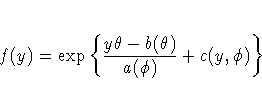
In generalized linear models, the response is assumed to possess a probability distribution

of the exponential form. That is, the probability density of the response Y for continuous response variables, or the probability function for discrete responses, can be expressed as
f(y) = \exp \{ \frac{y\theta - b(\theta)} {a(\phi)} + c(y,\phi) \}

for some functions a, b, and c that determine the specific distribution. For fixed, this is a one-parameter exponential family of distributions. The functions a and c are such that
a(\phi) = \phi / w
and
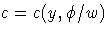
c = c(y, \phi / w)
, where w is a known weight for each observation. A variable representing w in the input data set may be specified in the WEIGHT statement. If no WEIGHT statement is specified, wi=1 for all observations.

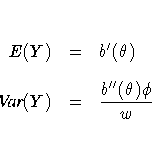
Standard theory for this type of distribution gives expressions for the mean and variance of Y.
E(Y) & = & b^'(\theta) \ {Var}(Y) & = & \frac{b^' '(\theta) \phi}w \

where the primes denote derivatives with respect to
\theta
.If
\mu
represents the mean of Y, then the variance expressed as a function of the mean is
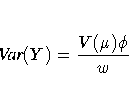
{Var}(Y) = \frac{V(\mu) \phi}w \

where V is the variance function.

Probability distributions of the response Y in generalized linear models are usually parameterized in terms of the mean
\mu
and dispersion parameter
\phi
instead of the natural parameter
\theta
.The probability distributions that are available in the GENMOD procedure are shown in the following list. The PROC GENMOD scale parameter and the variance of Y are also shown.

The negative binomial distribution contains a parameter k, called the negative binomial dispersion parameter. This is not the same as the generalized linear model dispersion
\phi
, but it is an additional distribution parameter that must be estimated or set to a fixed value.


For the binomial distribution, the response is the binomial proportion Y = events/ trials. The variance function is
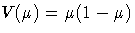
V(\mu) = \mu(1-\mu)
, and the binomial trials parameter n is regarded as a weight w.

If a weight variable is present,
\phi
is replaced with, where w is the weight variable.

PROC GENMOD works with a scale parameter that is related to the exponential family dispersion parameter
\phi
instead of with
\phi
itself. The scale parameters are related to the dispersion parameter as shown previously with the probability distribution definitions. Thus, the scale parameter output in the "Analysis of Parameter Estimates" table is related to the exponential family dispersion parameter. If you specify a constant scale parameter with the SCALE= option in the MODEL statement, it is also related to the exponential family dispersion parameter in the same way.

Link Function

The mean
\mu_i
of the response in the ith observation is related to a linear predictor through a monotonic differentiable link function g.

g(\mu_i) = {x_{i}}'{{\beta}}

Here, xi is a fixed known vector of explanatory variables, and
{\beta}
is a vector of unknown parameters.

Log-Likelihood Functions

Log-likelihood functions for the distributions that are available in the procedure are parameterized in terms of the means
\mu_i
and the dispersion parameter
\phi
.The term yi represents the response for the ith observation, and wi represents the known dispersion weight. The log-likelihood functions are of the form
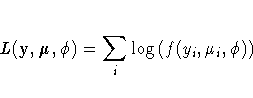
L(y,{\mu}, \phi) = \sum_i \log ( f(y_i,\mu_i,\phi) )

where the sum is over the observations. The forms of the individual contributions
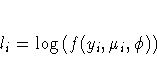
l_i = \log ( f(y_i,\mu_i ,\phi) )

are shown in the following list; the parameterizations are expressed in terms of the mean and dispersion parameters.

For the binomial, multinomial, and Poisson distribution, terms involving binomial coefficients or factorials of the observed counts are dropped from the computation of the log-likelihood function since they do not affect parameter estimates or their estimated covariances.

Maximum Likelihood Fitting

The GENMOD procedure uses a ridge-stabilized Newton-Raphson algorithm

to maximize the log-likelihood function
L(y,{\mu}, \phi)
with respect to the regression parameters.

By default, the procedure also produces maximum likelihood estimates of the scale parameter as defined in the

"Response Probability Distributions"

section for the normal, inverse Gaussian, negative binomial, and gamma distributions.

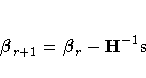
On the rth iteration, the algorithm updates the parameter vector
{{\beta}}_{r}
with

{{\beta}}_{r+1} = {{\beta}}_{r} - H^{-1}s

where H is the Hessian

(second derivative) matrix, and s is the gradient

(first derivative) vector of the log-likelihood function, both evaluated at the current value of the parameter vector. That is,

s = [s_j] = [ \frac{\partial L}{\partial \beta_j} ]

and

H = [{h_{ij}}] = [ \frac{\partial^2 L} {\partial\beta_i\partial\beta_j} ]

In some cases, the scale parameter is estimated by maximum likelihood. In these cases, elements corresponding to the scale parameter are computed and included in s and H.

If
\eta_i = {x_{i}}'{{\beta}}
is the linear predictor for observation i and g is the link function, then
\eta_i = g(\mu_i)
, so that
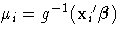
\mu_i = g^{-1}({x_{i}}'{{\beta}})
is an estimate of the mean of the ith observation, obtained from an estimate of the parameter vector
{\beta}
.

The gradient vector and Hessian matrix for the regression parameters are given by
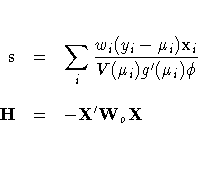
s & = & \sum_i \frac{w_i (y_i - \mu_i)x_i} {V(\mu_i) g^'(\mu_i) \phi} \ H & = & -X^'W_o X \

where X is the design matrix, xi is the transpose of the ith row of X, and V is the variance function. The matrix Wo is diagonal with its ith diagonal element
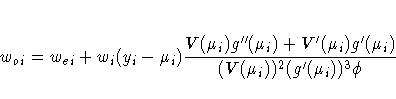
w_{oi} = w_{ei} + w_i(y_i - \mu_i) \frac{V(\mu_i)g^' '(\mu_i) + V^'(\mu_i)g^'(\mu_i)} {(V(\mu_i))^2 (g^'(\mu_i))^3 \phi}

where

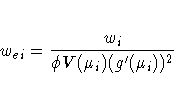
w_{ei} = \frac{w_i}{\phi V(\mu_i)(g^'(\mu_i))^2}

The primes denote derivatives of g and V with respect to
\mu
.The negative of H is called the observed information matrix.

The expected value of Wo is a diagonal matrix We with diagonal values wei. If you replace Wo with We, then the negative of H is called the expected information matrix.

We is the weight matrix for the Fisher's scoring

method of fitting. Either Wo or We can be used in the update equation. The GENMOD procedure uses Fisher's scoring for iterations up to the number specified by the SCORING option in the MODEL statement, and it uses the observed information matrix on additional iterations.

Covariance and Correlation Matrix

The estimated covariance matrix

of the parameter estimator is given by

{\Sigma} = -H^{-1}

where H is the Hessian matrix evaluated using the parameter estimates on the last iteration. Note that the dispersion parameter, whether estimated or specified, is incorporated into H. Rows and columns corresponding to aliased parameters are not included in
{\Sigma}
.

The correlation matrix is the normalized covariance matrix. That is, if
\sigma_{ij}
is an element of
{\Sigma}
, then the corresponding element of the correlation matrix is
\sigma_{ij}/\sigma_i\sigma_{j}
,where
\sigma_i = \sqrt{\sigma_{ii}}
.

Goodness of Fit

Two statistics that are helpful in assessing the goodness of fit

of a given generalized linear model are the scaled deviance

and Pearson's chi-square statistic.

For a fixed value of the dispersion parameter
\phi
, the scaled deviance is defined to be twice the difference between the maximum achievable log likelihood and the log likelihood at the maximum likelihood estimates of the regression parameters.

Note that these statistics are not valid for GEE models.

If
l(y, {\mu})
is the log-likelihood function expressed as a function of the predicted mean values
{\mu}
and the vector y of response values, then the scaled deviance is defined by
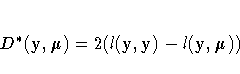
D^*(y, {\mu}) = 2(l(y,y) - l(y, {\mu}))

For specific distributions, this can be expressed as
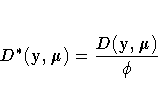
D^*(y, {\mu}) = \frac{D(y, {\mu})}{\phi}

where D is the deviance. The following table displays the deviance for each of the probability distributions available in PROC GENMOD.

In the binomial case, yi=ri/mi, where ri is a binomial count and mi is the binomial number of trials parameter.

In the multinomial case, yij refers to the observed number of occurrences of the jth category for the ith subpopulation defined by the AGGREGATE= variable, mi is the total number in the ith subpopulation, and pij is the category probability.

Pearson's chi-square statistic is defined as
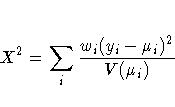
X^2 = \sum_i \frac{w_i( y_i - \mu_i)^2}{V(\mu_i)}

and the scaled Pearson's chi-square is
X^2 / \phi
.

The scaled version of both of these statistics, under certain regularity conditions, has a limiting chi-square distribution, with degrees of freedom equal to the number of observations minus the number of parameters estimated. The scaled version can be used as an approximate guide to the goodness of fit of a given model. Use caution before applying these statistics to ensure that all the conditions for the asymptotic distributions hold. McCullagh and Nelder (1989) advise that differences in deviances for nested models can be better approximated by chi-square distributions than the deviances themselves.

In cases where the dispersion parameter is not known, an estimate can be used to obtain an approximation to the scaled deviance and Pearson's chi-square statistic. One strategy is to fit a model that contains a sufficient number of parameters so that all systematic variation is removed, estimate
\phi
from this model, and then use this estimate in computing the scaled deviance of sub-models. The deviance or Pearson's chi-square divided by its degrees of freedom is sometimes used as an estimate of the dispersion parameter
\phi
.For example, since the limiting chi-square distribution of the scaled deviance
D^* = D / \phi
has n-p degrees of freedom, where n is the number of observations and p the number of parameters, equating D* to its mean and solving for
\phi
yields
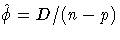
\hat{\phi} = D/(n-p)
.Similarly, an estimate of
\phi
based on Pearson's chi-square X2 is
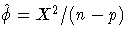
\hat{\phi} = X^2/(n-p)
.Alternatively, a maximum likelihood estimate of
\phi
can be computed by the procedure, if desired. See the discussion in the "Type 1 Analysis" section for more on the estimation of the dispersion parameter.

Dispersion Parameter

There are several options available in PROC GENMOD for handling the exponential distribution dispersion parameter.

The NOSCALE and SCALE options in the MODEL statement affect the way in which the dispersion parameter is treated. If you specify the SCALE=DEVIANCE option, the dispersion parameter is estimated by the deviance divided by its degrees of freedom. If you specify the SCALE=PEARSON option, the dispersion parameter is estimated by Pearson's chi-square statistic divided by its degrees of freedom.

Otherwise, values of the SCALE and NOSCALE options and the resultant actions are displayed in the following table.

NOSCALE SCALE=value Action present scale fixed at value present not present scale fixed at 1 not present not present scale estimated by ML not present present scale estimated by ML,     starting point at value

The meaning of the scale parameter displayed in the "Analysis Of Parameter Estimates" table is different for the Gamma distribution than for the other distributions. The relation of the scale parameter as used by PROC GENMOD to the exponential family dispersion parameter
\phi
is displayed in the following table. For the binomial and Poisson distributions,
\phi
is the overdispersion parameter, as defined in the "Overdispersion" section, which follows.

In the case of the negative binomial distribution, PROC GENMOD reports the "dispersion" parameter estimated by maximum likelihood. This is the negative binomial parameter k defined in the "Response Probability Distributions" section.

Overdispersion

Overdispersion

is a phenomenon that sometimes occurs in data that are modeled with the binomial or Poisson distributions. If the estimate of dispersion after fitting, as measured by the deviance or Pearson's chi-square, divided by the degrees of freedom, is not near 1, then the data may be overdispersed if the dispersion estimate is greater than 1 or underdispersed if the dispersion estimate is less than 1. A simple way to model this situation is to allow the variance functions of these distributions to have a multiplicative overdispersion factor
\phi
.

The models are fit in the usual way, and the parameter estimates are not affected by the value of
\phi
.The covariance matrix, however, is multiplied by
\phi
, and the scaled deviance and log likelihoods used in likelihood ratio tests are divided by
\phi
.The profile likelihood function used in computing confidence intervals is also divided by
\phi
.If you specify an WEIGHT statement,
\phi
is divided by the value of the WEIGHT variable for each observation. This has the effect of multiplying the contributions of the log-likelihood function, the gradient, and the Hessian by the value of the WEIGHT variable for each observation.

The SCALE= option in the MODEL statement enables you to specify a value of
{\sigma = \sqrt{\phi}}
for the binomial and Poisson distributions. If you specify the SCALE=DEVIANCE option in the MODEL statement, the procedure uses the deviance divided by degrees of freedom as an estimate of
\phi
,and all statistics are adjusted appropriately. You can use Pearson's chi-square instead of the deviance by specifying the SCALE=PEARSON option.

The function obtained by dividing a log-likelihood function for the binomial or Poisson distribution by a dispersion parameter is not a legitimate log-likelihood function. It is an example of a quasi-likelihood function. Most of the asymptotic theory for log likelihoods also applies to quasi-likelihoods, which justifies computing standard errors and likelihood ratio statistics using quasi-likelihoods instead of proper log likelihoods. Refer to McCullagh and Nelder (1989, Chapter 9) and McCullagh (1983) for details on quasi-likelihood functions.

Meet the Authors
Zacharia Maganga’s blog features multiple contributors with clear activity status.
Active ✔
🧑‍💻
Zacharia Maganga
Lead Author
Active ✔
👩‍💻
Linda Bahati
Co‑Author
Active ✔
👨‍💻
Jefferson Mwangolo
Co‑Author
Inactive ✖
👩‍🎓
Florence Wavinya
Guest Author
Inactive ✖
👩‍🎓
Esther Njeri
Guest Author
Inactive ✖
👩‍🎓
Clemence Mwangolo
Guest Author

x̄ - > Bloomberg BS Model - King James Rodriguez Brazil 2014

Bloomberg BS Model - King James Rodriguez Brazil 2014 🔊 Read ⏸ Pause ▶ Resume ⏹ Stop ⚽ The Silent Kin...

Labels

Data (3) Infographics (3) Mathematics (3) Sociology (3) Algebraic structure (2) Environment (2) Machine Learning (2) Sociology of Religion and Sexuality (2) kuku (2) #Mbele na Biz (1) #StopTheSpread (1) #stillamother #wantedchoosenplanned #bereavedmothersday #mothersday (1) #university#ai#mathematics#innovation#education#education #research#elearning #edtech (1) ( Migai Winter 2011) (1) 8-4-4 (1) AI Bubble (1) Accrual Accounting (1) Agriculture (1) Algebra (1) Algorithms (1) Amusement of mathematics (1) Analysis GDP VS employment growth (1) Analysis report (1) Animal Health (1) Applied AI Lab (1) Arithmetic operations (1) Black-Scholes (1) Bleu Ranger FC (1) Blockchain (1) CATS (1) CBC (1) Capital markets (1) Cash Accounting (1) Cauchy integral theorem (1) Coding theory. (1) Computer Science (1) Computer vision (1) Creative Commons (1) Cryptocurrency (1) Cryptography (1) Currencies (1) DISC (1) Data Analysis (1) Data Science (1) Decision-Making (1) Differential Equations (1) Economic Indicators (1) Economics (1) Education (1) Experimental design and sampling (1) Financial Data (1) Financial markets (1) Finite fields (1) Fractals (1) Free MCBoot (1) Funds (1) Future stock price (1) Galois fields (1) Game (1) Grants (1) Health (1) Hedging my bet (1) Holormophic (1) IS–LM (1) Indices (1) Infinite (1) Investment (1) KCSE (1) KJSE (1) Kapital Inteligence (1) Kenya education (1) Latex (1) Law (1) Limit (1) Logic (1) MBTI (1) Market Analysis. (1) Market pulse (1) Mathematical insights (1) Moby dick; ot The Whale (1) Montecarlo simulation (1) Motorcycle Taxi Rides (1) Mural (1) Nature Shape (1) Observed paterns (1) Olympiad (1) Open PS2 Loader (1) Outta Pharaoh hand (1) Physics (1) Predictions (1) Programing (1) Proof (1) Python Code (1) Quiz (1) Quotation (1) R programming (1) RAG (1) RL (1) Remove Duplicate Rows (1) Remove Rows with Missing Values (1) Replace Missing Values with Another Value (1) Risk Management (1) Safety (1) Science (1) Scientific method (1) Semantics (1) Statistical Modelling (1) Stochastic (1) Stock Markets (1) Stock price dynamics (1) Stock-Price (1) Stocks (1) Survey (1) Sustainable Agriculture (1) Symbols (1) Syntax (1) Taroch Coalition (1) The Nature of Mathematics (1) The safe way of science (1) Travel (1) Troubleshoting (1) Tsavo National park (1) Volatility (1) World time (1) Youtube Videos (1) analysis (1) and Belbin Insights (1) competency-based curriculum (1) conformal maps. (1) decisions (1) over-the-counter (OTC) markets (1) pedagogy (1) pi (1) power series (1) residues (1) stock exchange (1) uplifted (1)

Followers